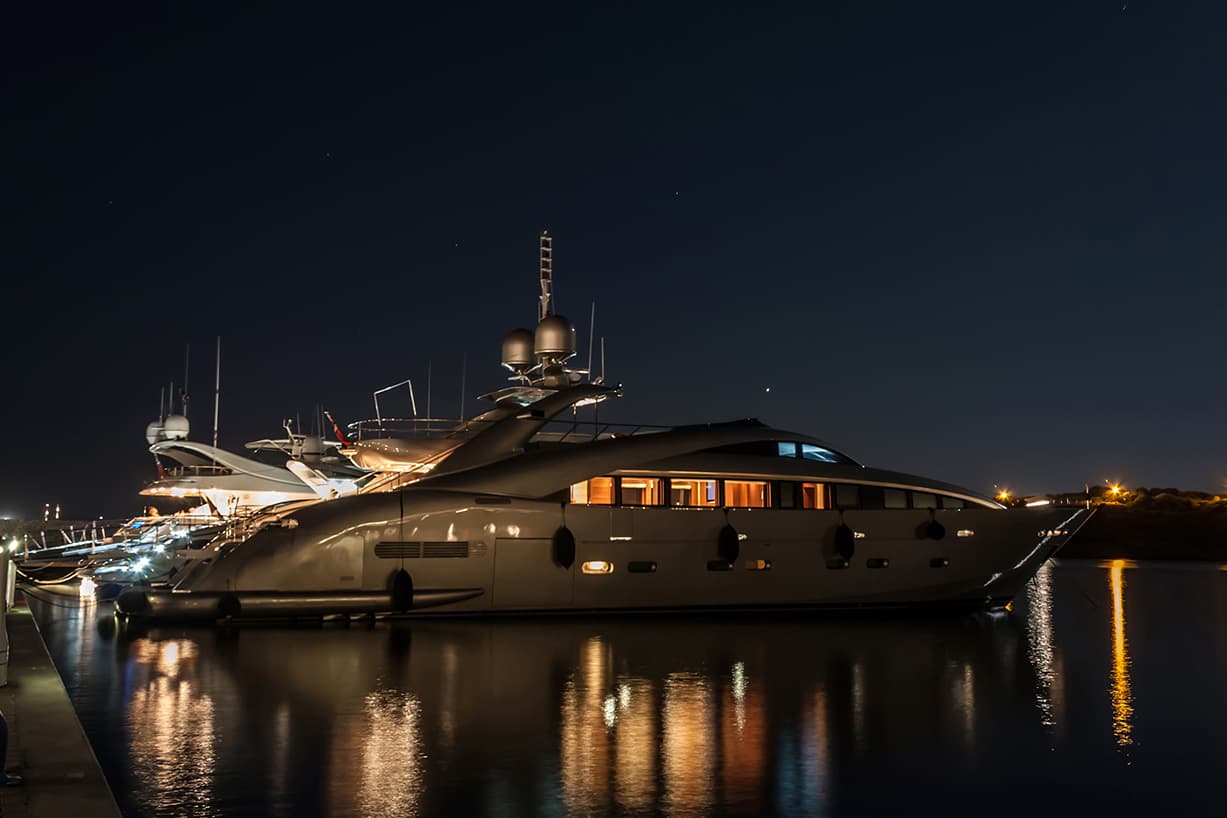
APRIL 2026 · 7 MIN · BERTHING · MIAMI
The market before the market
Miami's private berthing market does not clear on a website. It clears in a group of twenty or so dockmasters, captains, and yacht managers who share a season, a storm season, and an intuition about which principals will actually show.
By the time a slip is listed, it is already a second choice. The first choice was handed quietly — often months in advance — from one captain to another, on the strength of a previous call, a tip left in cash, or an incident handled without a complaint. The public chases listings. We arrange private access before the listing exists.
Nothing about the 2026 Miami season contradicts that. If anything, the asymmetry has widened.
Why the 130–180ft bracket is locked through Q3
The 130 to 180-foot bracket is the Miami squeeze. It is large enough to demand real beam and real power, small enough that owners bring them in routinely for winter, FII-adjacent calendars, and Art Basel-adjacent entertaining. Every credible marina in the county is holding most of that bracket for returning clients through the end of Q3.
A first-time principal arriving in February, expecting to dock a 160-foot vessel at Island Gardens Deep Harbour on two weeks' notice, is working from the brochure version of Miami. The real version is a waitlist that does not publish its ordering.
There are remedies. None of them look like the listings page. They look like a phone call placed a year in advance, or a relationship inherited through a trusted intermediary.
Sea Isle vs Island Gardens vs Fisher Island — operational tradeoffs
Sea Isle Marina sits inside the city. It is the working address. Provisioning, crew rotation, tender launches, and late-night returns are all simpler. The principal trades a degree of privacy for operational convenience. For a principal who is actually using the yacht as a moving office during the Miami leg, Sea Isle is often the correct answer, not a compromise.
Island Gardens Deep Harbour is the photograph. Deeper draft, more ceremony, the one most commonly requested by name. It is also the most tightly held. A slip at Island Gardens in peak season is rarely moved on price. It is moved on relationship, pedigree of vessel, and the captain the principal employs.
Fisher Island is the soft answer. A principal who wants the vessel visible to the right circle, and invisible to everyone else, often ends up here. The tradeoff is logistical — everything moves on the ferry schedule or the tender — which captains either love or quietly dread.
Bill Bird Marina and Miami Beach Marina both remain credible for the 80 to 130-foot range, and for owners who would rather be on Alton Road than on Watson Island. They are not, however, answers for a principal who needs discretion as a product.
The captains run the marina, not the brochures
It is important for a first-time principal to understand this clearly. The marina office prints the contract. The dockmaster decides where the boat actually goes. And the captain decides whether the dockmaster ever gets a second call.
That ecology is why a captain with ten clean years in South Florida is worth more than a twenty-page marketing deck. He is the one who will place the call that moves a vessel two hundred feet — from an exposed outside slip to a quiet inside finger — on the night weather turns.
A principal who underinvests in captain quality will over-invest in marina drama for the rest of the season.
The short version: the dockmaster will take the captain's call at six on a Friday evening. He will not take a new principal's. That is not arrogance. That is bandwidth.
What a principal should ask before arrival
The questions that matter are rarely the ones on the intake form.
Not what the slip fee is. Who holds the slip now, and when does their contract roll. Not whether power is available. Whether the boat's draw at peak demand has ever tripped the pedestal. Not whether there is security. Whether the security staff rotates in from a third-party vendor, or whether the same three faces have been on that dock for five years.
Not whether the marina permits entertaining. Whether a quiet dinner for twelve on a Thursday has, in fact, happened in the last ninety days without generating a neighbor complaint. The brochure answer to all of these is yes. The operator answer is specific, and almost always conditional.
The Elegasea protocol
Our protocol for a Miami arrival is quiet. We do not negotiate with inventory. We negotiate for access. A principal briefs the desk once, with the vessel's particulars, the arrival window, the tolerance for visibility, and the use case — berthing, entertaining, both, or neither. We handle the rest bilaterally.
The outcome the principal sees is a single, calm confirmation. The work behind it is several weeks of calls, context, and restraint. We do not invoice for effort. We invoice for placement.
If there is a constant in the 2026 Miami berthing market, it is that the public-facing supply has narrowed and the private-facing supply is healthy — for principals who know how to ask, through whom, and in what order.
Silence is the product. Berthing is the mechanism.